
Over the years, India-EU ties have grown, and covered trade, investment, climate change, science and technology, space, digital, mobility, and connectivity.

Guterres emphasised that global structures and institutions must reflect the complexity and the opportunity of the "new times and realities"

President Donald Trump has withdrawn the United States from over 60 international organisations, including United Nations bodies and the India-France-led International Solar Alliance, calling the institutions 'redundant' and 'contrary' to America's interests.
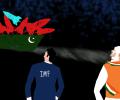
It is time for India to raise its voice not just through military prowess, but through professionalism, principled voting and partnerships, asserts Deepak Mishra.

Their shared brief: To assert India's case with clarity, rebut hostile narratives, and secure enduring partnerships for global counter-terror cooperation.

Muraleedharan said that terrorist groups such as Al-Shabaab have put in place elaborate revenue collection networks, to support their terrorist activities.
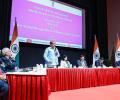
JD-U MP Sanjay Kumar Jha heads a diplomatic mission to Indonesia, Malaysia, South Korea, Japan and Singapore, to seek international cooperation after the Pahalgam attack while highlighting Pakistan's role in cross-border terrorism.
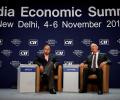
Top 10 trends for 2015 are deepening income inequality; jobless growth; lack of leadership; rising geostrategic competition; weakening of representative democracy; rising pollution in developing world; rising occurrence of severe weather events; intensifying nationalism increasing water stress and growing importance of health in the economy.
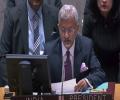
Jaishankar, who presided over the UNSC Briefing: Global Counterterrorism Approach: Challenges and Way Forward, described terrorism as an existential threat to international peace and security and said it knows no borders, nationality, or race.

Russia on Monday accused the US of "actively" exploiting the "contradictions" between India and China to its advantage and asserted Moscow and New Delhi accumulated mutual trust and confidence based on decades-old ties that would help the two sides to deal with the current geopolitical turbulence.

India also called for crippling the illicit drug trade which provides financial sustenance to these terror outfits.

The resolution, drafted by France and Tunisia, 'demands a general and immediate cessation of hostilities in all situations on its agenda and supports the efforts undertaken by the Secretary-General and his Special Representatives and Special Envoys'.
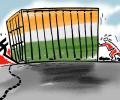
India needs a National Trade Policy Council, chaired by a minister who reports directly to the PM, says Jayanta Roy, former economic advisor to the Union commerce ministry.
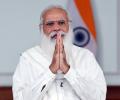
The main elements of the programme are bilateral meetings with the US leadership, participation in the Quad Leaders' Summit, address at the UN General Assembly and business interactions.

Addressing the plenary session of the 11th Asia-Europe Meeting Summit here in the Mongolian capital, Vice President Hamid Ansari said, "all our societies today face unprecedented levels of threat from terrorism in all its manifestations. The most recent example is what has happened, most unfortunately in France."

After two decades, the SCO appears to be at a cross-roads with the US withdrawal from Afghanistan, asserts Srikanth Kondapalli, the leading China expert.

Proliferation and potential use of nuclear weapons pose the most dangerous threat to global security and peace, US President Barack Obama has said.

The US intends first to cripple the Afghan government financially through sanctions, freezing of assets, denial of access to international banking, etc, and then proceed to do pretty much what it wants to do with scant regard for Afghanistan's sovereignty, predicts Ambassador M K Bhadrakumar.

Modi emphasised on deeper India-Africa partnership on clean energy.
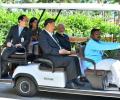
'Only when China treats India as an equal can we consider them real friends.'

During his two-day stay in Silicon Valley, he would begin and conclude his engagements with the Indian-American community, the last one being an address to a crowd of over 18,500 Indian-Americans at the SAP Centre in San Jose.

'Kofi Annan will be remembered more for his Nobel Prize and related glory rather than Rwanda and Volcker,' notes Ambassador T P Sreenivasan with whom he worked in the UN.
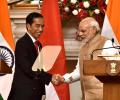
The two countries, among the very few fast growing large economies globally, also decided to boost bilateral trade and investment in areas of oil and gas, renewable energy, IT and pharmaceuticals, during talks between Prime Minister Narendra Modi and Indonesian President Joko Widodo.

If indeed we want the board to manage the RBI, probably the government should take a close look at the US Federal Reserve system which has a two-part structure - a central authority in Washington, DC, and a decentralised network of 12 Federal Reserve Banks located throughout the country, says Tamal Bandyopadhyay.

Swaraj said there is scope to do a lot more and this would be an important element of their deliberations.

Swaraj emphasised that the UN must accept it needs fundamental reform.

'This novel format of diplomacy -- the informal summit -- will not only facilitate bilateral communication and reduce miscalculations at the very top level of the two governments, but possibly open the space for China and India to speak in one voice on various issues of mutual concern,' note Feng Renjie and Ding Kun Lei

China sees India and Japan's 'North East Road Network Connectivity Improvement Project' as a challenge to its OBOR, says Rajaram Panda.

'Previous governments in India had reservations about working with Israel.' 'Modi has shed this tag.' 'Disengaging itself from its traditional and ideological foreign policy approach in the Middle East shall serve India's long-term interests.' Rajaram Panda explains why the significance of Modi's visit to the Jewish nation goes beyond markers like the first-ever visit to Israel by an Indian PM and 25 years of diplomatic ties.

Moving ahead with their new mantra -- Chalein Saath Saath: Forward Together We Go -- Prime Minister Narendra Modi and United States President Barack Obama on Tuesday vowed to deepen cooperation in every sector for the benefit of global stability and people's livelihoods over the next ten years.

This is the joint statement issued by the ministry of external affairs on the visit of US President Barack Obama to India.

Even as the United States snuggles closer to India with the thinly veiled objective of containing China, the Indian strategy is to avoid alienating either nation.

'India is no longer the India of the '70s and the '80s.' 'It's a large country with the fastest growing economy.' 'In working with India, you just can't go and humiliate the nation publicly.' USIBC President Mukesh Aghi tells Aziz Haniffa/Rediff.com about how he advises American companies to do business with India, what he thinks of Modi's government and the way forward for the India-US relationship.
'Modi and Abe are working seriously for India-Japan bonhomie to grow stronger.' 'It is a win-win situation for both countries and the future look promising,' says Rajaram Panda, the Indian Council for Cultural Relations India Chair Visiting Professor at Reitaku University, Japan.

'It is in the interest of both sides that the visit of the US President is seen as being successful. Both sides have invested considerable political capital in it. This rapid exchange of visits and the decisions taken have to be justified, beyond the symbolism, which is no doubt important in itself. This opportunity to impart a fresh momentum to ties should not be missed,' says former foreign secretary Kanwal Sibal.

PM Modi seems to be gradually ending India's strategic ambiguity

'We are completely engaged in fighting poverty; alas, our neighbour Pakistan seems only engaged in fighting us.'

Focus on the best you can do with what you've been given.

President Pranab Mukherjee on Monday addressed the first joint sitting of Parliament as mandatorily required under the Constitution after the general elections. The address is the political, economic and foreign policy road map of the Narendra Modi government and covers virtually all crucial areas.
